


Learning From The Germans - Confronting Race And The Memory Of Evil
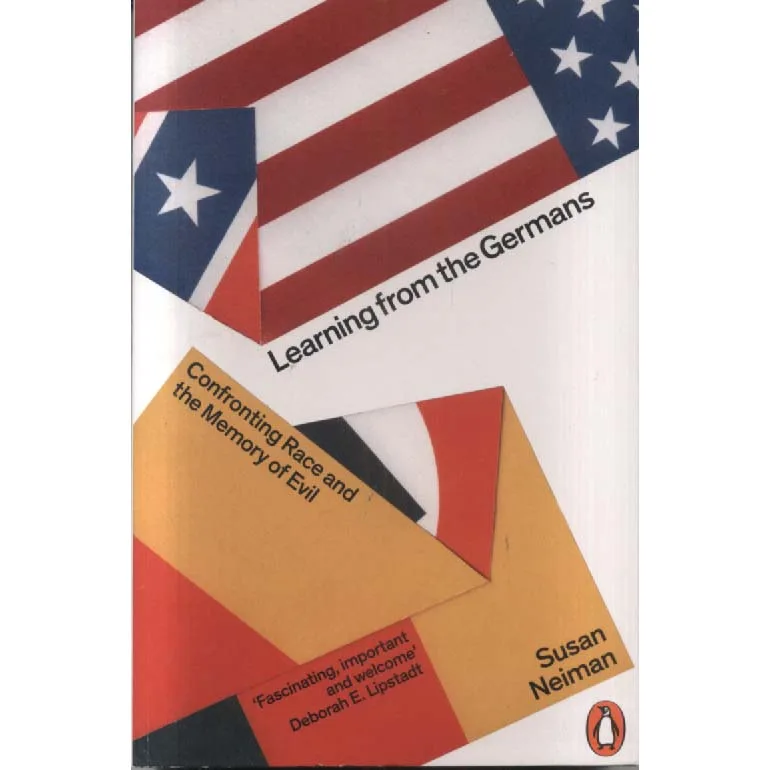
Publisher: Penguin
Format: Paperback
ISBN: 9780141983424
Learning from the Germans – Confronting Race and the Memory of Evil (2020) by Susan Neiman
Penguin
ISBN: 9780141983424
Condition: Good
Some countries prefer to remember their past selectively.
The victories are polished.
The statues are dusted.
The uncomfortable bits are moved quietly towards the back of the cupboard and labelled “complicated”.
Susan Neiman’s Learning from the Germans asks what happens when a nation does the opposite.
Her starting point is Germany’s long and painful effort to confront the crimes of the Nazi era: not simply by acknowledging that terrible things happened, but by building remembrance, education, public debate and moral responsibility into the national culture.
This process has a formidable German word attached to it: Vergangenheitsaufarbeitung — roughly, “working through the past”.
The word itself is long enough to suggest that the process was never going to be easy.
Neiman then takes that German experience and places it alongside the United States’ struggle with slavery, racism and the legacy of white supremacy, particularly in the American South.
The question at the heart of the book is provocative but simple:
What can one society learn from another about facing historical wrongdoing?
This is not an exercise in declaring that Germany has achieved moral perfection.
It plainly has not.
Nor is it an attempt to claim that the Holocaust and American slavery are identical historical events.
They are not.
Instead, Neiman is interested in the mechanisms of memory: how societies acknowledge crimes, how they teach them, which monuments they erect, which myths they preserve, and what happens when people decide that confronting the past is an attack on the present.
That last problem may sound familiar.
Neiman spent many years living in Germany and brings an unusual perspective to the subject as an American Jewish philosopher observing both countries from close range.
She examines memorials, education, politics, public culture and personal testimony, asking why some societies eventually build a collective language for responsibility while others remain trapped in endless arguments about whether anything should be discussed at all.
Germany provides an extraordinary case study.
After 1945, there was no instant national awakening in which everybody simultaneously announced that they had reflected deeply on recent events.
There was denial.
Silence.
Defensiveness.
Generational conflict.
And a great deal of reluctance.
In other words, people behaved like people.
The transformation came gradually, driven by education, activism, historical research, political pressure and younger generations asking increasingly awkward questions about what their parents and grandparents had done.
Awkward questions are rarely popular.
They are, however, remarkably good at opening archives.
Neiman contrasts this with the American experience of slavery and racial violence, particularly the long cultural struggle over the Confederacy and the way Civil War memory was reshaped after Reconstruction.
Monuments, commemorations and historical narratives became part of that battle.
A statue, after all, is never merely a large object somebody forgot to move.
It says something about who is considered worthy of honour.
That is why arguments about monuments become so ferocious.
Stone is remarkably good at holding political meaning.
Neiman travels through the American South speaking to activists, historians, community leaders and others engaged with the region’s difficult history.
She also explores places where people are attempting to make that history visible rather than merely more comfortable.
The result is part philosophy, part history, part reportage and part argument about moral responsibility.
It asks whether nations can mature in the same way individuals supposedly can: by admitting what happened, accepting responsibility and trying not to repeat it.
Human beings, unfortunately, have developed several ingenious alternatives.
Denial is popular.
So is nostalgia.
There is also the ever-reliable method of announcing that discussing historical injustice is somehow more divisive than the injustice itself.
Neiman is particularly interested in the idea of national identity.
Can patriotism survive an honest view of history?
Must national stories always involve heroic ancestors performing noble deeds beneath impressive flags?
Or might a mature national identity include the ability to say, “This was wrong”?
Germany suggests that shame and responsibility do not necessarily destroy a country’s identity.
They may, in fact, become part of rebuilding it.
But Learning from the Germans is not a comfortable book about one enlightened country instructing everybody else.
Neiman is alert to Germany’s own failures and contradictions, and she repeatedly shows that remembrance is a process rather than a certificate awarded once the correct number of memorials has been constructed.
History keeps moving.
People keep arguing.
And every generation develops new reasons why now is apparently not the right time to discuss something unpleasant.
For readers interested in modern history, race, political philosophy, memory, the Holocaust, the American South or the politics of commemoration, this is a challenging and unusually wide-ranging book.
It is also a reminder that remembering the past is not the same thing as being imprisoned by it.
Sometimes refusing to remember is what keeps societies trapped.
This Penguin edition from 2020 is in Good condition, which is more than can be said for several of the historical legacies examined inside.
Available from Crappy Old Books, where the past cannot be changed, but it can at least be read about properly before somebody erects another statue.
Keep browsing: See more History books Other books by Susan Neiman
